-

CAP
With the project CAP – Cultures, Arts & Politics, Distanz e. V. empowers young people aged 12 to 18 in rural regions of Thuringia through creative youth culture and media workshops. By strengthening young people’s constructive interests and fostering their sense of self-efficacy, democratic participation and networking are made attractive and accessible – directly within their everyday environments.
Why CAP?
Especially in times of intensive media use and social media engagement, young people need physical spaces where they can meet, engage creatively, think critically and constructively, and explore social issues in a democratically oriented way. CAP creates exactly these kinds of spaces – youth-oriented, low-threshold, and inspired by democratic values.
Our Approach
Participants choose from a diverse range of workshops with a youth-cultural, media-educational, and political-historical focus. The workshops are conducted by gender-balanced two-person teams with specific expertise and further training provided by Distanz e. V.
Project Goals
- Developing democratic action competence, encounter, and social responsibility
- Reaching young people in rural areas through life-world-oriented approaches
- Promoting creativity, reflection, and self-efficacy
- Strengthening extracurricular networking

Project Structure
Phase 1 – Introduction and Selection
During project days, participants select their preferred workshops from a diverse repertoire. The activities take place in youth clubs, residential facilities, or through school social work – extracurricular and voluntary.
Phase 2 – Deepening and Engagement
Interested participants from Phase 1 take part in multi-day intensive workshops in their regions. This creates recurring interest-based encounters, local networking, and a strong sense of democratic community.
Phase 3 – Networking Across Thuringia
Life-world-oriented workshops and supra-regional “peak events” connect participants from different regions. The goal: Thuringia-wide networks that strengthen and inspire young people in their democratic engagement.

Key Elements of Implementation
- Participatory workshop selection by participants
- Democratic, life-world-oriented content
- Space for expectations and individual interests
- Appreciative and creative exchange
- Gender-balanced facilitator teams
Project Duration
01 May 2023 – 01 May 2028
Gefördert durch

Kooperationspartner
-

KI(B)T
Intervening Competently Within (Vocational School) Teams: How can vocational schools or youth institutions respond professionally to far-right attitudes and forms of group-focused hostility? The KI(B)T project strengthens educational professionals in their daily work – in a practical, long-term, and sustainable way – to effectively address these challenges.
Project Formats
KI(B)T supports educators in developing a confident and reflective approach when working with young people who are vulnerable to or already oriented toward far-right entry pathways. The measures promote both individual action competence and institutional change.
1. Intensive Coaching: Long-Term Team Support
Through intensive coaching, Distanz e. V. supports vocational schools for up to one year. In interdisciplinary teams consisting of teachers, school leadership, and school social workers:
- Challenges and resources are jointly analyzed
- Institution-specific goals are formulated
- Appropriate measures are implemented and reflected upon
Goals of Intensive Coaching
- Development of long-term action strategies in response to far-right tendencies
- Strengthening team competence and professional confidence in everyday practice
2. Flex-C: Short Format with Sustainable Impact
The new coaching format Flex-C is a shorter support format for educators, running parallel to preventive workshops for young people within the same institution. These workshops focus on youth culture, political-historical education, and experiential learning approaches.
Goals of Flex-C
- Initial analysis of challenges and resources
- Development of first steps toward a competent response to far-right tendencies
- Sustainable integration of preventive workshop content

3. Further Training: Intervention Program in a radicalisation process as a Cross-Cutting Task
Intervention Program in a radicalisation process belongs at the core and across the full spectrum of social work practice. In practical training sessions, participants learn conversation and intervention methods for both short- and long-term application.
Goals of the Further Training Programs
- Strengthening confidence in dealing with group-focused hostility and far-right orientations
- Transfer of content into everyday educational practice
- Anchoring the Intervention Program in a radicalisation process across various fields of action
4. Preventive Workshops: Learning in a Life-World Context
The workshops for students use life-world-oriented approaches rooted in youth culture, political-historical education, and experiential learning. They address personal experiences, social developments, and foster critical thinking.
Project Duration
01 January 2025 – 31 December 2026
Further Information
Flex-C Info Flyer (PDF, approx. 3 MB)
Coaching Info Flyer (PDF, approx. 250 KB)Gefördert durch
-
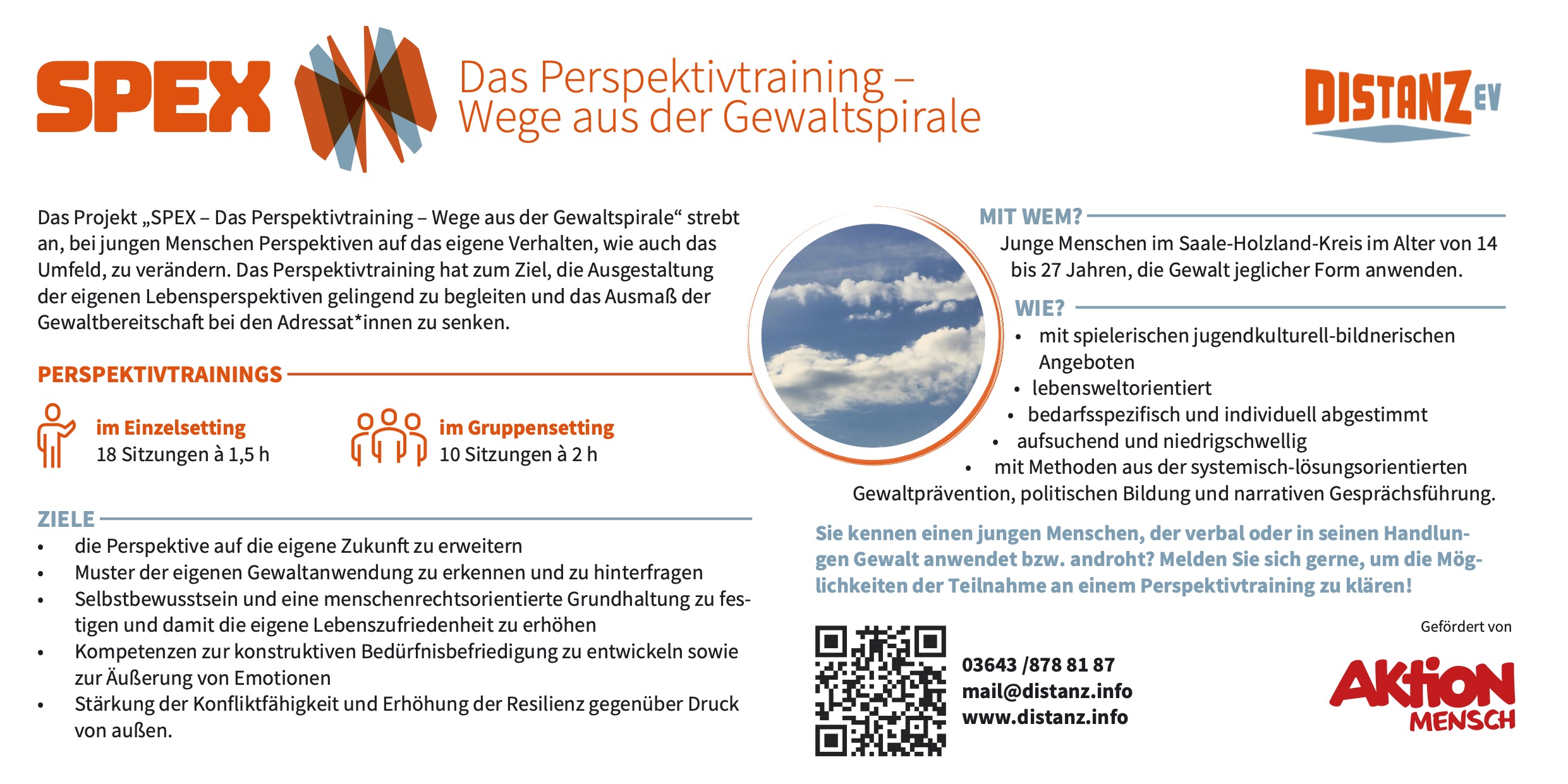
SPEX
SPEX is a training program for young people in the Saale-Holzland district that counteracts violent behavior and opens up new perspectives. The aim is to promote life plans free from violence, reflect on behavioral patterns, and strengthen individual abilities – through lifeworld-oriented, low-threshold, and participatory methods.
What does SPEX achieve?
The training supports young people in:
- actively shaping their life perspective in a non-violent way
- better understanding themselves and their actions
- resolving conflicts constructively
- developing self-confidence and resilience against peer pressure

Target Group
- Young people between the ages of 14 and 27
- People of all genders, with and without disabilities
- Regardless of origin or social background
- Especially individuals facing multiple challenges (e.g., addiction, domestic violence, unstable relationships)
Training Formats
- Individual setting: 18 sessions of 1.5 hours each
- Group setting: 10 sessions of 2 hours each
Both formats begin with five preparatory meetings. The appropriate training format is selected together with the referring institution.
Special Features of the Project
- Involvement of the social environment: Significant others are actively included and can provide impulses.
- Extended support: Recommendations for complementary measures (e.g., parental counseling, systemic family support).
- Former participants as peer trainers
- Integration of playful youth cultural and educational activities
Project Objectives
1. Planning the Future – Free from Violence
Young people develop their own non-violent life perspectives and receive support in organizing their leisure time and planning their future.
2. Strengthening Self-Reflection
Through targeted questions, participants learn to recognize their own patterns of thinking and behavior and to develop new courses of action.
3. Enhancing Conflict Skills
Strengthening personal agency, developing alternative conflict resolution strategies, and building resilience against peer pressure.
Project Duration
01.01.2025 – 31.12.2027
Further Information
SPEX Flyer (PDF, approx. 580 KB)
Gefördert durch
-
Transform
With Transform, Distanz e. V. is reshaping the Intervention Program in a radicalisation process nationwide. We contribute our many years of experience to further develop concepts and structures in this field of work. The goal is to find new and effective ways to support young people in distancing themselves from far-right attitudes and groups – closely connected to their everyday lives.
What is Transform?
Transform – Intervention Program in a radicalisation process to overcome distance from democratic values and to prevent entry into right-wing extremism is an innovation project being piloted in four model regions in Thuringia.
The approaches and methods developed are designed for nationwide impact and for the qualification of professionals. The focus lies on new formats, target groups, methods, and forms of cooperation.
Project Focus Areas
Trainer Tandem – Anchoring the Intervention Program in a radicalisation process Locally
Experienced trainers from Distanz e. V. work in tandems with local professionals – for example from schools, youth welfare services, or probation services. Together, they conduct Deradicalisation Trainings and establish a foundation that enables these professionals to independently carry out Intervention Programs in a radicalisation process in the future.
Advisory Institution Youth Welfare Office – Practical Support
Distanz e. V. becomes a permanent point of contact for youth welfare offices. Our advisors support staff in assessing risks of radicalisation – for example during care planning meetings – thereby strengthening professional confidence in working with young people at risk.
Expanded Target Group – Reaching Young People in Transitional Phases
We deliberately expand the target group to include children from the age of 10 as well as young adults up to 27 years. Life transitions are particularly vulnerable phases for radicalisation. We adapt the formats of the Intervention Program in a radicalisation process to be age-appropriate and make them accessible to new target groups.
Distancing Through Play – Gamification as a Method
Playful elements make complex topics tangible. By integrating gamification into our methods, we create new pathways for reflection – especially for younger participants. This approach promotes insight and change in creative and intuitive ways while strengthening motivation.
Online Meets Offline – Hybrid Intervention Program in a radicalisation process
Young people move in both digital and analog spaces. Transform develops methods that connect these two worlds. Content from online work flows into offline trainings – and vice versa. The results are shared nationwide with educational and civil society actors.
Professionally Supported – The Science-Practice Advisory Board
An interdisciplinary advisory board provides critical and consultative support to the project. The focus lies particularly on developing lifeworld-oriented methods and on specifically reaching female addressees.
Project Duration
January 2025 – December 2028
Further Information
Transform Flyer (PDF, approx. 300 KB)
Training program “Was los im Feed?”Gefördert durch

-

Zentrum für Distanzierungsarbeit (ZfD)
The ZfD is the central advisory institution in Thuringia for the field of Intervention Program in a radicalisation process. It supports professionals working with young people who show signs of group-focused hostility or early far-right tendencies. The aim is to intervene at an early stage – before dehumanising attitudes become entrenched.
Target Group
The advisory service is aimed at:
- Educators across all fields of youth work and schools
- Staff from youth welfare offices
- Other multipliers within the educational sector
Approach
The Intervention Program in a radicalisation process bridges the gap between preventive democracy education and traditional exit work.
- Low-threshold and straightforward
- Timely
- Tailored / individualised
- Resource-oriented
- Networked and fostering networks
- Prioritised according to needs based on clear criteria, including rural risk situations, lack of resources, and threat scenarios

ZfD Formats
Counselling and Coaching
Initial contact can be made by phone or email and, if desired, anonymously. In the next step, a joint needs assessment takes place, during which the staff of Distanz e. V., together with those involved, analyse the individual situation. Based on this, a tailored and individualised support plan is developed in line with the specific needs identified. The further counselling process includes case-related strategies and may, if required, transition into coaching or a Deradicalisation Training. In addition, a multi-professional networking approach ensures that relevant professionals from the young person’s environment are involved in the process.
Peer Case Consultation
The focus is on the joint analysis of complex cases, incorporating scene-specific knowledge. On this basis, concrete strategies for action are developed and strategically planned within the team. Upon request, this process can be supplemented by integration into a further Deradicalisation Training.
Modular Training Programmes
The ZfD offers topic-specific training programmes using a modular system. These trainings are aimed at both individuals and teams and are designed to be resource-oriented, needs-based, individualised, and flexible in terms of scheduling.
Deradicalisation Training
The ZfD supports young people aged 10 to 27 in individual and group trainings to help them distance themselves from hostile and violence-supporting attitudes. Using systemic, solution-focused, and reflective methods, impulses for distancing are encouraged. The work is both critically confrontational and relationship-strengthening, with the participants’ goals at the centre. Through youth cultural, media-related, and historical interests, connections to the young people’s lifeworlds are created, and their sense of self-efficacy is strengthened.
Funding Period
01 January 2025 – 31 December 2032
Gefördert durch
Projects